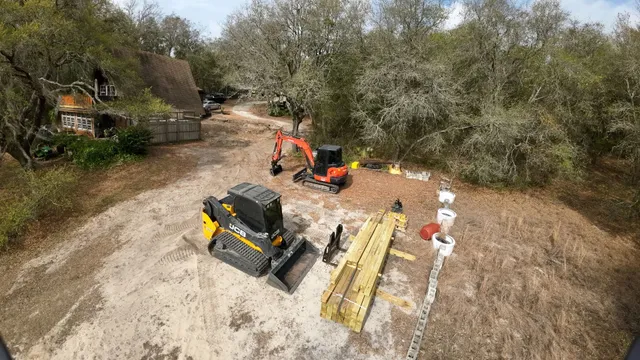
Choosing the right lot is the single most important decision you'll make when building a custom home. On the Gulf Coast—from Pensacola to Mobile, from Gulf Breeze to Gulf Shores—the land itself tells a story. The soil composition, elevation, drainage patterns, and even the trees growing on the property all provide clues about your future construction costs and the long-term stability of your home.
After building hundreds of homes across Florida and Alabama, we've learned that the "perfect" lot isn't just about the view or the neighborhood. It's about practical factors that affect your budget, timeline, and peace of mind. This guide will teach you how to read a lot like a professional builder, saving you thousands in unexpected costs and preventing headaches down the road.
1. Understanding Gulf Coast Soil Types
Florida and Alabama Gulf Coast regions have diverse soil compositions that directly impact your foundation design and construction costs. Before you fall in love with a view, you need to understand what's beneath your feet.
Sandy Soils: The Coastal Standard
Most of the Gulf Coast—from Pensacola Beach to Orange Beach—features sandy or sandy-loam soils. This is generally excellent news for builders:
Benefits of Sandy Soils
- Superior drainage: Sandy soils prevent water pooling around foundations, reducing flood risk
- Easy excavation: Less heavy equipment time means lower site prep costs (typically $2,000-$4,000 less than clay areas)
- Stable for foundations: Properly compacted sand provides excellent bearing capacity for slab foundations
Clay and Silt Pockets
Inland areas around Milton, Pace, and parts of Mobile County often contain clay-heavy soils. These require special attention:
- Expansion concerns: Clay expands when wet and contracts when dry, potentially causing foundation movement
- Drainage challenges: Poor percolation means you may need engineered drainage systems
- Septic considerations: Clay soils often require larger drain fields or alternative septic systems
Pro Tip: Soil Testing
Always request a geotechnical soil report ($800-$1,200) before purchasing a lot in inland areas. In flood zones, this report is often required for permitting anyway, so get it early to inform your decision.
2. The Perc Test: Your Septic System Gatekeeper
If your lot isn't connected to municipal sewer (common in rural Escambia, Santa Rosa, and Baldwin County areas), you'll need a septic system. And where there's a septic system, there's a perc test.
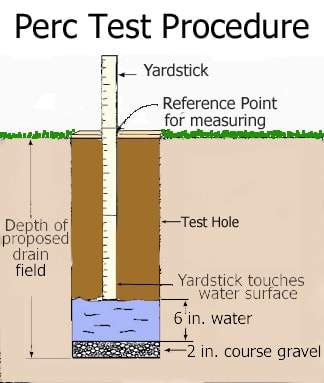
A percolation test (perc test) measures how quickly soil absorbs water. Here's what Gulf Coast buyers need to know:
- Timing matters: Test during the wet season (typically January-March in our region) for conservative results
- Sandy coast vs. inland: Beach areas typically perc at 1-5 minutes per inch (excellent), while clay-heavy inland areas may take 30+ minutes per inch (acceptable but requires larger drain fields)
- Test location: You'll need tests in the exact area where you plan to place the drain field, not just anywhere on the lot
- Health Department involvement: In Florida, county health departments must witness perc tests. In Alabama, licensed engineers or sanitarians perform them
Red flag: If a seller refuses to allow a perc test before closing, walk away. Failed perc tests are one of the leading reasons building lots become unsellable.
3. Flood Zone Assessment: Non-Negotiable on the Coast
Living on the Gulf Coast means living with water. Smart builders don't avoid flood zones—they understand and engineer for them.
Reading FEMA Flood Maps
Every lot in Florida and Alabama has a flood zone designation. Here's what the codes mean for your build:
Key Flood Zone Designations
- Zone X (Minimal Risk): Areas outside the 500-year floodplain. Lower insurance rates and fewer building restrictions
- Zone A (High Risk): Areas with a 1% annual chance of flooding (100-year floodplain). Requires elevation and flood insurance
- Zone AE (High Risk with BFE): Similar to Zone A but with established Base Flood Elevations (BFE). Most common in Pensacola and Gulf Breeze
- Zone VE (Coastal High Risk): Areas along coastlines subject to wave action. Strictest building requirements, including breakaway walls and elevated foundations
Elevation Certificates and Fill
If your lot is in Zone AE (common in Gulf Breeze, Navarre, and Perdido Key), you'll need an elevation certificate. This survey ($500-$800) determines:
- How high your finished floor must be (typically BFE + 1-2 feet freeboard)
- Whether you need engineered fill to raise the building pad
- Your flood insurance premiums (lower floor = higher premiums)
Fill dirt costs $15-$25 per cubic yard delivered and compacted on the Gulf Coast. For a typical 2,000 sq ft home pad raised 2 feet, budget $8,000-$15,000 in fill costs alone.
4. Topography and Drainage: The Slope Story
Flat lots aren't always better. Ideally, your building site should have:
- 1-3% grade away from the foundation: Natural drainage prevents water intrusion
- High and dry positioning: Even within a lot, micro-elevation matters. That beautiful oak in the lowest corner might indicate a seasonal pond
- Swale awareness: Check if the lot has (or needs) swales—shallow drainage channels that direct water around rather than through your home

5. Trees: Assets and Obstacles
Gulf Coast live oaks and slash pines add character and value—but they also add complexity.
Protected Species
Both Florida and Alabama have protected tree ordinances:
- Escambia County, FL: Requires replacement for trees over 12" diameter at breast height (4.5 ft above ground)
- Santa Rosa County, FL: Protected tree list includes live oaks, slash pines, and magnolias over specific calipers
- Baldwin County, AL: Buffer requirements near wetlands and protected species habitats
Root Zones and Foundations
Keep large trees at least 1 foot away from the foundation for every 1 inch of trunk diameter at breast height. A 30-inch oak needs to be 30 feet from your slab to prevent root intrusion and foundation heave.
Tree Value vs. Removal Cost
Mature live oaks add $10,000-$50,000 to property value in Gulf Coast markets. Before clearing everything, consider designing your home around specimen trees. The architectural interest they provide often outweighs the slight inconvenience of working around them.
6. Utilities and Access
The "perfect" lot loses its charm if you can't get power, water, and internet to it affordably.
Power Availability
In rural areas of Escambia, Baldwin, and Mobile counties:
- Overhead lines: Typically $25-$50 per linear foot to extend from existing poles
- Underground service: $75-$150 per linear foot, but required in many newer developments
- Transformer costs: If the lot needs a new transformer, add $3,000-$8,000
Water and Sewer vs. Well and Septic
Municipal water connection fees vary dramatically:
- City of Pensacola: Water impact fees around $1,200-$2,500 depending on meter size
- Gulf Breeze: Connection fees plus availability charges can reach $5,000+
- Unincorporated areas: Well drilling ($6,000-$12,000 for 100-200 ft depth typical of our area)
7. The View vs. Build Cost Equation
Waterfront lots command premiums, but they also command higher construction costs:
Waterfront Construction Considerations
- Wind codes: Beachfront properties require enhanced wind resistance (higher cost per square foot)
- Elevation requirements: Waterfront is often Zone AE or VE, requiring expensive fill or piling foundations
- Setback requirements: Coastal Construction Control Lines (CCCL) in Florida may push your buildable area back 50+ feet from the dune line
- Access challenges: Narrow beach lots often require specialized equipment and material handling
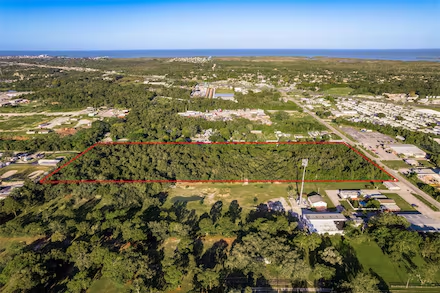
Downloadable Lot Evaluation Checklist
Print this checklist and take it with you when evaluating potential building sites:
Pre-Purchase Lot Evaluation Checklist
Frequently Asked Questions
Lot clearing costs in Florida typically range from $1,500 to $5,000 per acre for lightly wooded areas, and $3,000 to $8,000+ for heavily wooded lots. In the Gulf Coast region, factors like tree density, stump removal, and terrain affect pricing. Always get a site survey before clearing to protect valuable trees and avoid protected species.
A perc test (percolation test) measures how quickly soil absorbs water. It's required in Florida and Alabama if you're installing a septic system. The test determines the size of drain field needed. Sandy soils typical of Gulf Coast areas usually pass easily, while clay-heavy soils may require alternative systems.
Yes, you can build in Flood Zone AE (Special Flood Hazard Area) in Florida, but you must elevate your home's lowest floor to or above the Base Flood Elevation (BFE). Additional requirements include flood-resistant materials below BFE and proper anchoring. Modern building techniques make flood-zone construction safe and insurable.
Unincorporated Escambia County requires a minimum of 1 acre for septic system installation, though some exceptions exist for legacy lots. Within municipal boundaries like Pensacola or Gulf Breeze, minimum lot sizes vary by zoning district—typically 6,000-10,000 sq ft for single-family residential. Always verify current zoning with the county or city planning department before purchasing.
Site preparation typically takes 2-6 weeks depending on complexity. Clearing and rough grading take 3-5 days, utility installation 1-2 weeks, and final grading/pad preparation 3-5 days. Wet weather, protected species discoveries, or unexpected soil conditions can extend this timeline. We recommend beginning site work 60 days before your target foundation pour date.
Ready to Build on Your Lot?
Bring us your lot for a free feasibility consultation. We'll assess soil conditions, flood requirements, and provide a detailed site preparation estimate before you buy.
Browse Elevated Home Plans